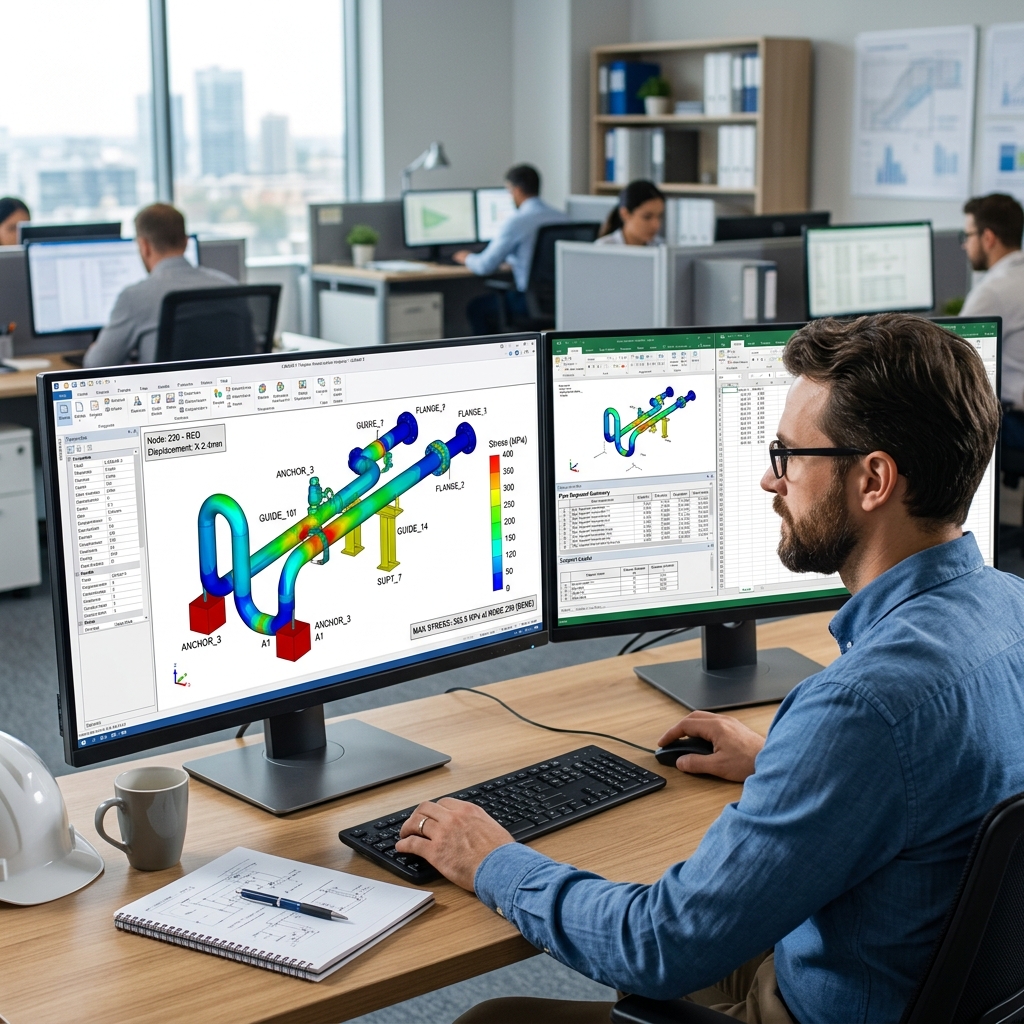
Chilled Water Stress Analysis
Pipe Stress Analysis plays a crucial role in determining the appropriate supports needed to handle various loading conditions for chilled water pipelines.
Chilled water pipelines are a massive capital investment in commercial infrastructure, district cooling, and industrial facilities. To ensure long-term durability and efficiency, simulation-based designs are not just recommended—they are essential.
At RT Creative Engineers, we conduct comprehensive Static and Dynamic Stress Analysis for diverse pipeline systems, including Chilled Water, Hot Water, and Condensing Water networks. Our analyses mitigate the risk of catastrophic failures caused by thermal expansion, extreme weight loads, and operational vibrations.
By precisely identifying maximum forces and moments, we provide engineered solutions for support placements, anchor points, and expansion joints, guaranteeing that your piping network operates safely within allowable stress limits.
Explore Our Methodology ↓Technical Expertise
We utilize industry-leading software like CAESAR II to model complex stress scenarios and deliver actionable engineering solutions.
Evaluating stresses induced by sustained loads such as pipe weight, fluid weight, insulation, and internal design pressure. We ensure the pipe doesn't yield under its own operational state.
Calculating the exact thermal growth or contraction in chilled/hot water lines. We design specialized expansion loops and specify expansion bellows to absorb movement safely.
Determining the optimal span between supports, selecting the right support types (spring hangers, guides, fixed anchors), and calculating the exact loads transferred to the building structure.
Simulating transient loads such as water hammer, pump trips, and valve closures to ensure the piping network and supports can withstand sudden, extreme force spikes.
Safety and regulatory compliance are non-negotiable. Our stress analysis reports are recognized by authorities and consultants worldwide, strictly adhering to the following codes:
Bypassing formal pipe stress analysis, especially on pipes larger than 150mm (6") or networks subjected to high temperature differentials, poses massive risks.
Without engineered flexibility, thermal expansion forces will transfer directly to vulnerable equipment nozzles (chillers, pumps, AHUs), voiding manufacturer warranties and risking catastrophic equipment failure.
Furthermore, inadequate support spacing leads to pipe sagging, poor drainage, and excessive vibration, dramatically reducing the lifespan of the entire HVAC infrastructure.
Workflow
A rigorous, step-by-step approach from initial drawing review to final IFC drawing generation.
1. Data Gathering & 3D Modeling
We review your isometric drawings, P&IDs, equipment specs, and material data. We then build an accurate 3D node-based model of the piping system in CAESAR II.
2. Load Case Definition
Our engineers define all operational, sustained, and occasional load cases (temperature extremes, test pressures, wind, and seismic if applicable).
3. Simulation & Iteration
We run the stress simulation. If stress thresholds or equipment nozzle loads exceed allowable code limits, we iteratively modify pipe routing or support configurations until the system passes.
4. Final Support Selection
We precisely specify the locations and types of all supports—including spring hangers (calculating cold/hot loads), rigid hangers, guides, line stops, and anchors.
5. Deliverables Generation
We deliver a comprehensive Pipe Stress Analysis Report along with annotated AutoCAD drawings detailing exact support locations, loads, and expansion joint specifications for the site team.
Connect with our stress analysis specialists for ASME-compliant chilled water pipeline analysis.
Request a Consultation